
Dreamer Q Journal
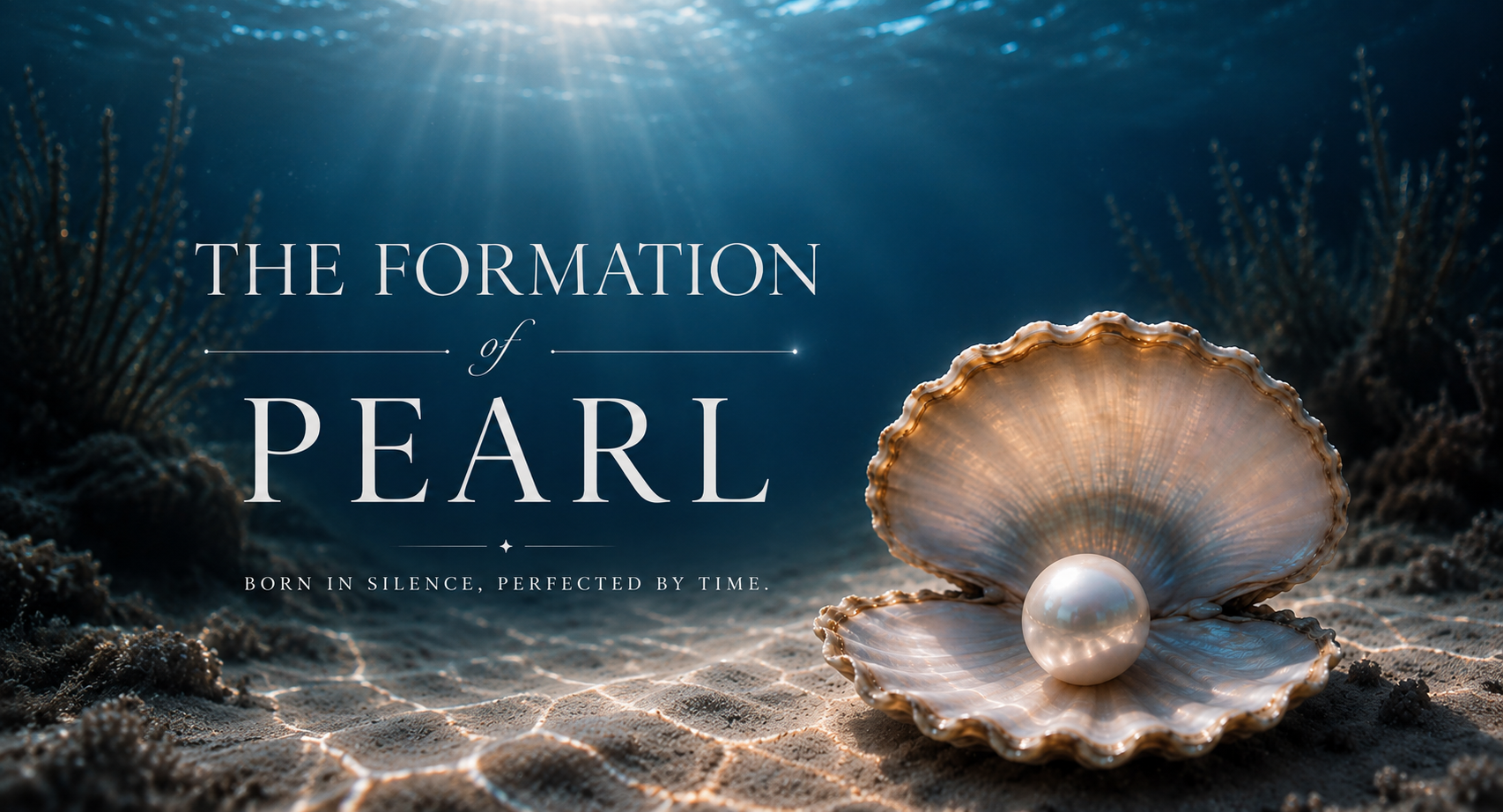
Born from patience.
Shaped by time.
Shaped by time.
The quiet miracle of how a pearl comes to be.
The Beginning
A pearl does not begin
as something beautiful.
as something beautiful.
It begins as an interruption — a tiny grain of sand, a fragment of shell, or a parasite that finds its way inside the soft body of an oyster or mollusc. To protect itself, the creature responds with the only thing it knows: layer after layer of a lustrous substance called nacre.
What began as a wound slowly becomes one of nature's most extraordinary creations. Not despite the irritation — but because of it.
How it happens
Four stages of a miracle.
01
The Irritant Enters
A tiny foreign particle — often a grain of sand, a fragment of shell, or a microscopic organism — makes its way inside the soft mantle tissue of a mollusc. The creature cannot expel it. So it adapts.
02
Nacre Begins to Form
The mantle tissue secretes nacre — a combination of calcium carbonate crystals (aragonite) and an organic protein called conchiolin. This is the same material that lines the inside of the shell, giving it that iridescent glow. Layer by microscopic layer, the nacre wraps around the irritant.
03
Years of Quiet Growth
This process does not happen overnight. A freshwater pearl takes 2 to 7 years to form. A South Sea pearl may take up to 4 years. Akoya pearls, prized for their perfect roundness, require at least 18 months in carefully maintained waters. Every layer adds depth, lustre, and character.
04
The Pearl Emerges
When harvested, the pearl is cleaned, sorted, and graded. No two are identical. Shape, colour, lustre, surface — each one carries the story of the specific oyster, the specific water, the specific years it spent becoming what it is. This is what makes natural pearls irreplaceable.
The Science of Nacre
Why does a pearl
glow the way it does?
glow the way it does?
The secret lies in the structure of nacre itself. Each microscopic layer of aragonite crystals is incredibly thin — around 0.5 microns — and semi-transparent. Light passes through the outermost layers, bounces off the deeper ones, and returns to the eye slightly shifted. This interference of light waves creates the signature pearl glow: an inner radiance that seems to come from within rather than from the surface.
The thicker the nacre, the deeper and more complex this optical effect. This is why pearl farmers speak of nacre thickness as the most important indicator of quality — it is the difference between a pearl that merely reflects light, and one that seems to hold it.
"A pearl is the only gem created entirely by a living creature — not formed by heat or pressure, but by patience and care."
Not all pearls are the same
Each ocean tells
a different story.
a different story.
Freshwater
Rivers & Lakes
Grown in mussels in freshwater lakes. Known for its wider variety of shapes and natural colours. The most accessible natural pearl — and often the most expressive.
Formation: 12 months – 7 years
Akoya
Saltwater
The classic pearl. Known for exceptional roundness, mirror-like lustre, and cool white to rose overtones. Grown in the Pinctada fucata oyster in cold saltwater bays.
Formation: 18 months – 2 years
South Sea
Saltwater
The largest and rarest of cultured pearls. Grown in the Pinctada maxima oyster in warm tropical waters. Remarkable for their size, thick nacre, and warm golden or white satiny glow.
Formation: 2 – 4 years
Tahitian
Saltwater
Grown in the black-lipped Pinctada margaritifera oyster. Famous for their naturally dark colours — deep grey, peacock green, aubergine, midnight blue. No two are alike.
Formation: 18 months – 4 years
A final thought
Every pearl you wear
began as something
the ocean could not ignore.
began as something
the ocean could not ignore.
There is something quietly remarkable about wearing a natural pearl — knowing that the lustre on your skin took years to form, layer by patient layer, inside a living creature. That is not just jewellery. That is time, made wearable.
Dreamer Q · Journal